Trek Overview
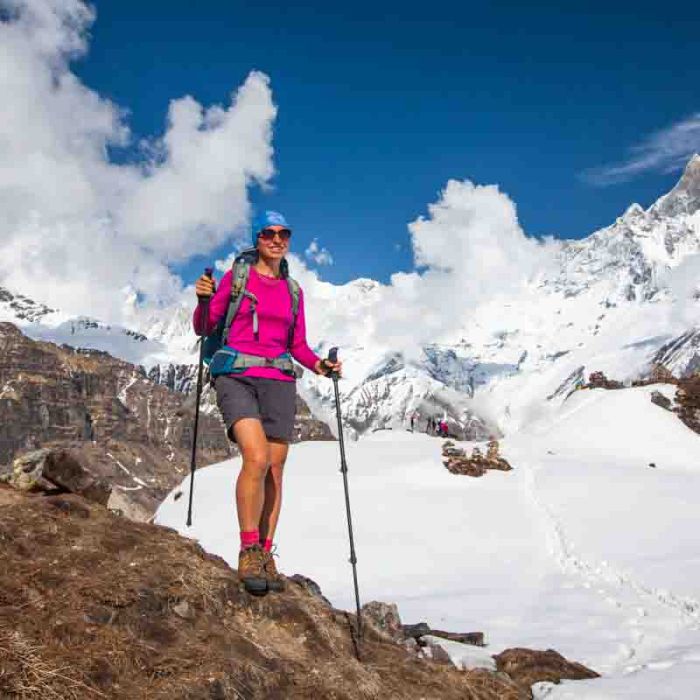
Also known as the Annapurna Sanctuary Trek, this is one of the great Himalayan journeys: twelve days that take you from the temples of Kathmandu, through terraced farmland and rhododendron forest, up into a natural amphitheatre ringed by 7,000 and 8,000 metre peaks.
The trail passes through the Annapurna Conservation Area, home to wildlife such as the red panda and the Himalayan monal, and brings you face to face with Annapurna I (8,091 m), Machapuchare (6,993 m) and Gangapurna (7,455 m). Skies are clearest in spring (March to May) and autumn (September to November).
Trip at a glance
- Region: Annapurna, Nepal (Himalaya)
- Route: Kathmandu, Pokhara, Annapurna Base Camp and back
- Maximum altitude: 4,130 m (13,550 ft)
- Duration: 12 days, Kathmandu to Kathmandu, with 8 days of trekking
- Dates: flexible — this trek runs on the dates you request
- Difficulty: Moderate to Challenging
- Accommodation: hotels in Kathmandu and Pokhara, teahouses on the trail
- Group: English-speaking leader throughout, one porter per two trekkers
What makes this trek special
- Waking up inside the Annapurna Sanctuary and watching sunrise light up the peaks — for most people, the moment of the whole trip.
- Soaking in the natural hot springs at Jhinu Danda after a week on the trail.
- Staying in Gurung and Magar villages, where the hospitality is as memorable as the mountains.
- Pokhara itself, with the Himalayas reflected in the still water of Phewa Lake.
Is this trek for you?
There is no technical climbing and no previous Himalayan experience is needed. What the trek does ask for is a good level of general fitness and the willingness to walk for several days in a row, with plenty of ascent and descent. It is a significant step up from a UK day walk, and considerably less demanding than Everest Base Camp. If you can comfortably manage a long, hilly day hike in the UK and you are prepared to keep doing that for a week, you will enjoy this trek.
Altitude
The trek reaches 4,130 m, so acclimatisation matters. The itinerary is paced to give your body time to adjust, and your guide will monitor how everyone is doing each day. Stay hydrated, eat properly and never feel you have to hide how you feel — tell the guide. You must have travel and medical insurance that covers trekking at altitude, and if you have any health concerns, please speak to your doctor before booking.
Itinerary
Twelve days from Kathmandu to Kathmandu, with eight days of trekking.
Day 1: Arrival in Kathmandu
Altitude 1,300 m (4,264 ft) · Hotel, double sharing · Breakfast
Arrive at Tribhuvan International Airport, where a representative will meet you and transfer you to your hotel (for example Hotel Marshyangdi or similar). Rest and recover from the flight, then join your guide for a full briefing on the days ahead.
Day 2: Kathmandu to Pokhara
Altitude 820 m (2,690 ft) · Hotel, double sharing · Breakfast
Travel from Kathmandu to Pokhara, either by 25-minute flight or by road (7 to 8 hours by car, 5 to 6 by tourist bus). On arrival you transfer to your hotel (for example Hotel Lake Star or similar). If time allows, there is a chance to go boating on Phewa Lake and visit the Barahi Temple on its small island.
Day 3: Pokhara to Ghandruk — the trek begins
Altitude 1,940 m · About 5 hours walking · Teahouse, double sharing · All meals
A private transfer of around 1.5 hours takes you to Nayapul, where the walking starts. Roughly five hours of trekking brings you up to the Gurung village of Ghandruk, with your first proper mountain views opening up along the way.
Day 4: Ghandruk to Chomrong
Altitude 2,020 m · About 6 hours walking · Teahouse, double sharing · All meals
A six-hour day of gentle climbs and descents through terraced valleys, with impressive views throughout. Overnight in Chomrong, the gateway village to the Annapurna Sanctuary.
Day 5: Chomrong to Bamboo
Altitude 2,505 m · Teahouse, 3 to 4 person sharing · All meals
Leave Chomrong along the Modi Khola river, crossing a suspension bridge before the climb to Sinuwa Dada. The trail runs through dense rhododendron forest and drops down steep stone steps into the bamboo groves that give tonight's stop its name.
Day 6: Bamboo to Deurali
Altitude 3,210 m · About 4 to 5 hours walking · Teahouse, 3 to 4 person sharing · All meals
A steady climb through bamboo and rhododendron forest, with lunch at a lodge in Dovan before continuing up to Deurali. You are now well above 3,000 m and the landscape begins to open out towards the sanctuary.
Day 7: Deurali to Annapurna Base Camp — the high point
Altitude 4,130 m (13,550 ft) · Teahouse, 3 to 4 person sharing · All meals
The big day. Climb from Deurali into the Annapurna Sanctuary, a natural amphitheatre ringed by some of the highest peaks on earth. Depending on conditions and how the group is feeling, we may stop at Machhapuchhare Base Camp or continue for a further two hours to Annapurna Base Camp itself.
Day 8: Annapurna Base Camp down to Bamboo
Altitude 2,400 m · Teahouse, 3 to 4 person sharing · All meals
An early start for sunrise over the sanctuary, then breakfast before the descent, retracing the route through Machhapuchhare Base Camp, Deurali and Dovan to Bamboo, past waterfalls and forest with views back to Machapuchare and Hiunchuli.
Day 9: Bamboo to Jhinu Danda and the hot springs
Altitude 1,760 m · Teahouse, double sharing · All meals
A steep climb to Kuldi Ghar, then stone steps via Sinuwa to Lower Chhomrong, up again to Upper Chhomrong and finally down to Jhinu Danda. The natural hot springs are a 20-minute walk from the village, and after a week on the trail they are hard to beat.
Day 10: Jhinu Danda to Nayapul, transfer to Pokhara
Last day of trekking · Hotel, double sharing · Breakfast
The final stretch of walking, from Jhinu Danda via New Bridge and Kyumi village, then on after lunch through Syaulibazar and Birethati. About an hour beyond Birethati you reach Nayapul and the trek ends. A 1.5-hour drive takes you back to Pokhara, with the afternoon free by the lake.
Day 11: Pokhara back to Kathmandu
Hotel, double sharing · Breakfast and farewell dinner
Return to Kathmandu after breakfast, again by 25-minute flight or by road (7 to 8 hours, around 200 km) through hills, rivers and rural villages. The trip finishes with a farewell dinner at a traditional Nepali restaurant.
Day 12: Departure
A transfer takes you to the airport at least 3 hours before your scheduled flight, and you head home with the Himalayas behind you.
Please note
Hotels and teahouses are named as examples and may change depending on availability for your chosen dates. The guide may also adjust the day-to-day plan for weather, trail conditions or the wellbeing of the group. Your safety always comes first.
What's Included
Everything below is covered by the trip price, so there are no surprises once you are on the trail.
Accommodation and meals
- Two nights in Kathmandu and two nights in Pokhara, 3-star hotel, twin sharing, bed and breakfast.
- The best available lodge and teahouse accommodation throughout the trek, twin sharing.
- All meals on the trek — breakfast, lunch and dinner — with tea or coffee at each meal.
- Tea and biscuits on arrival at the teahouse each afternoon, and fresh fruit after dinner.
- A chocolate bar each day on the trail.
- Farewell dinner at a traditional Nepali restaurant, with a cultural programme.
Guides, porters and permits
- An experienced, English-speaking trekking leader throughout.
- Sherpa porters, one porter per two trekkers.
- All guide and porter salaries, food, accommodation, equipment, insurance and government taxes.
- All national park fees and permits, including the Annapurna Conservation Area permit and TIMS card.
- All administration fees and local taxes.
Transport
- Airport arrival and departure transfers by private car.
- Kathmandu to Pokhara and back, by flight or tourist bus.
- Private transport from Pokhara to Nayapul at the start of the trek, and back to Pokhara at the end.
Equipment and extras
- Sleeping bag and trekking kit bag, on loan for the whole trek.
- Annapurna Base Camp trekking map.
- Group medical kit carried by the guide.
- Annapurna Base Camp trek completion certificate.
What's Not Included
Please budget separately for
- International flights to and from Nepal.
- Travel and medical insurance. This is essential and must cover trekking to at least 4,500 m, including emergency helicopter evacuation and repatriation.
- Emergency rescue or evacuation costs, which are claimed through your insurance policy.
- Nepal visa fee on arrival. Bring the exact amount in US dollars in cash, plus two passport-sized photographs.
- Lunch and dinner in Kathmandu and Pokhara, including any days you come off the trek earlier than planned.
- Extra nights' accommodation in Kathmandu or Pokhara beyond the itinerary.
- Personal expenses such as laundry, bar bills, bottled or boiled water, hot showers, device charging, phone calls and shopping.
- Tips for your guide and porters. These are not obligatory, but they are customary in Nepal and always appreciated. We will give you guidance on the usual amounts before you travel.
Good to Know
Hidden gems along the route
The Annapurna Base Camp trail is famous for its scenery, but it hides a few extras. A little-known path near Chhomrong leads down to the Jhinu Danda hot springs, and sunrise at Poon Hill turns the whole range gold. Ask your guide — they know exactly where and when to look.
Cultural etiquette
You will be a guest in Gurung and Magar villages. Greet people with a polite “Namaste”, avoid pointing your feet towards people or shrines, remove your shoes before entering a monastery or temple, and always ask before taking someone's photograph. Small courtesies are noticed and appreciated.
Weather and what to pack
Conditions in the Annapurna region change quickly. Spring and autumn are generally mild and clear, but nights at altitude are cold. Dress in layers, bring a reliable waterproof jacket, and protect yourself from the strong high-altitude sun with a hat and high-factor sunscreen. A full kit list is in our gear guide.
Staying well on the trail
Drink plenty of water, take regular breaks and eat properly — local Thakali meals and dhindo are excellent trail fuel. Carry high-energy snacks for the long days. If you feel unwell at any point, tell your guide straight away rather than pressing on.
Phones, Wi-Fi and charging
Most teahouses have Wi-Fi, though it slows down the higher you go, and local SIM cards are easy to buy in Pokhara. Charging is often paid for by the hour, so a power bank is worth its weight.
Looking after the mountains
The Annapurna Conservation Area is rich in wildlife and under real pressure from visitor numbers. Carry a reusable bottle and refill at safe drinking-water stations rather than buying plastic, stay on the marked trails to limit erosion, and take all your waste back down with you. Choosing local teahouses and local staff also keeps the money in the valleys you are walking through.
A little local folklore
Annapurna is named after the goddess of nourishment, and the mountains here are considered sacred. Machapuchare, the fishtail peak that watches over the sanctuary, has never been officially climbed — by local wish, its summit remains untouched.
After the trek
If you can spare a few extra days, Pokhara is a fine place to recover. The lakeside city has wellness retreats, yoga and traditional Ayurvedic massage, along with boating and paragliding, all under the same mountain skyline you have just walked through.
Ready for the Himalayas?
This trek runs on the dates you request. Get in touch with your preferred dates and we will confirm teahouse availability and the final itinerary, then secure your place with a £150 deposit. The remaining balance is due 30 days before departure.
Reserve your place
Gear Guide and Tips