
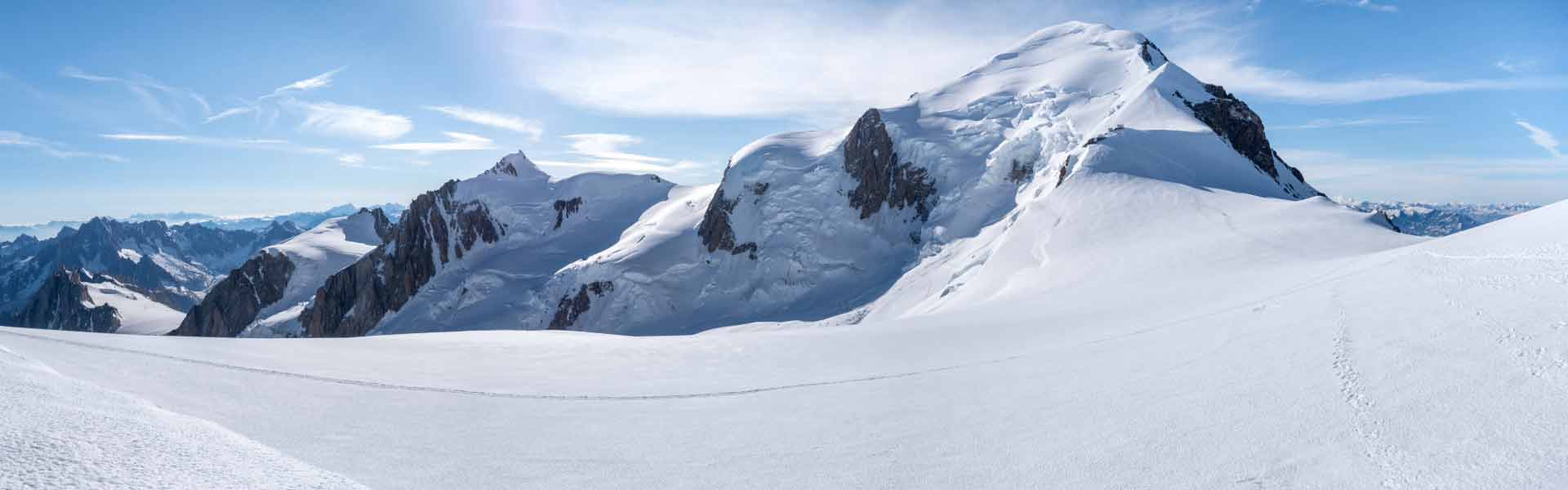
Mont Blanc Expedition 2027: the Goûter Route from Chamonix
Five days, four thousand eight hundred metres, and the highest summit in western Europe. This is our flagship alpine objective — a real mountaineering expedition on the classic Goûter route, guided, in a small group, with two nights in mountain huts and a 4am start for the summit.
The expedition at a glance
Is this expedition for you?
Mont Blanc is not a hike. The normal route crosses a glacier, climbs mixed rock and snow, and finishes on an exposed ridge above 4,700 m. You will be roped to your guide, in crampons, with an ice axe, for most of two days. Around 20,000 people attempt it each year and it claims lives every season.
To join, you need all of the following:
- Prior alpine experience. At least one glaciated peak, or a completed alpine skills course, within the last two years.
- Confidence in crampons and with an ice axe, including moving roped on a glacier and basic self-arrest.
- A serious level of hill fitness. You should be able to climb 1,000 m of ascent carrying a pack, on consecutive days, without it ruining you.
- A head for exposure. The Bosses Ridge is narrow with long drops on both sides.
- Insurance covering mountaineering and helicopter rescue above 4,000 m. Standard travel policies do not.
If you do not have the alpine experience yet, talk to us anyway. We will tell you honestly what to do first, and there is no shame in doing this a year later and standing on top rather than turning round at the Vallot hut.
The route
The voie normale is the classic and most travelled way up Mont Blanc, and the one every guide in Chamonix knows by heart. It is graded PD in the French alpine system: the climbing itself is straightforward, but the altitude, the length and the objective dangers are what make it serious.
From the top of the Tramway du Mont-Blanc at Nid d'Aigle, the route climbs to the Tête Rousse hut, crosses the notorious Grand Couloir du Goûter, then follows the Goûter ridge to the refuge. Summit day crosses the Dôme du Goûter, passes the Vallot emergency shelter, and finishes along the Bosses Ridge to the summit.
Nid d'Aigle
2,372 m
The top station of the Tramway du Mont-Blanc, the highest rack railway in France, and where the walking starts.
Refuge de Tête Rousse
3,167 m
Our first night, on the edge of the Tête Rousse glacier, facing the north-west face of the Aiguille de Bionnassay.
Grand Couloir du Goûter
3,300 m
A rockfall-swept gully crossed one at a time, fast, helmets on. Between 1990 and 2011 it caused 74 deaths and 180 injuries.
Refuge du Goûter
3,817 m
The futuristic timber-and-steel hut that opened in 2013, bolted to the ridge. Our launch pad for summit day.
Dôme du Goûter
4,304 m
A broad snow dome crossed in the dark. The point where most people first feel the altitude properly.
Vallot hut and the Bosses Ridge
4,362 m
Vallot is an emergency shelter, not a stop. Above it, the Bosses Ridge narrows to a snow crest all the way to the top.
Itinerary
- Tuesday 31 August — London to ChamonixTravel from London to Geneva by air or rail, then transfer to Chamonix. Check in, full equipment check with your guide, briefing on the route and the plan, and an early night.No climbing. Overnight in Chamonix, 1,035 m.
- Wednesday 1 September — Nid d'Aigle to Tête RousseCable car and the Tramway du Mont-Blanc to Nid d'Aigle, then climb to the Tête Rousse hut. An acclimatisation walk above the hut in the afternoon, then dinner and an early night at 3,167 m.Approx. 800 m ascent · 3 to 4 hours. Overnight at Tête Rousse.
- Thursday 2 September — Tête Rousse to the GoûterA short but serious day: the Grand Couloir crossing at first light, then the Goûter ridge to the refuge. The rest of the day is rest, hydration and altitude adaptation — it is work, not idleness.Approx. 650 m ascent · 3 to 4 hours. Overnight at the Goûter, 3,817 m.
- Friday 3 September — Summit dayAway at 4am by head torch. Dôme du Goûter, past the Vallot hut, along the Bosses Ridge to the summit of Mont Blanc. Then all the way back down: Goûter, Tête Rousse, Nid d'Aigle, and a transfer to Geneva.Approx. 1,000 m ascent and 2,400 m descent · 10 to 12 hours. Overnight in Geneva.
- Saturday 4 September — Geneva to LondonA free morning in Geneva, then the flight or train home. Legs sore, photos taken, something crossed off a list you will never forget.No climbing. Return to London.
What is included
- 1 night in Chamonix
- 2 nights in mountain huts with full board: dinner, breakfast and a packed lunch
- 1 night in Geneva at the end of the trip
- All mountain hut reservations, which are compulsory on this route and are checked
- Cable car, mountain tramway and local train tickets
- Transfers between Geneva and Chamonix
- Qualified mountain guiding on the mountain, in a small roped group
- Group coordination and logistics throughout
Not included
- Flights or rail travel between London and Geneva
- Personal insurance covering mountaineering and helicopter rescue above 4,000 m
- Technical equipment hire, easily arranged in Chamonix — ask us and we will book it
- Meals in Chamonix and Geneva, and drinks at the huts
Equipment
Technical kit — required, no exceptions
- Mountaineering boots, crampon-compatible and broken in
- Crampons fitted to your boots before you travel
- Ice axe, walking length
- Climbing harness
- Helmet — worn from Tête Rousse upwards, without argument
- Two locking carabiners and a 120 cm sling
- Head torch with fresh batteries, plus a spare set
- Category 4 glacier sunglasses and ski goggles for wind on the ridge
All of this can be hired in Chamonix. Tell us in advance and we will have it reserved and waiting.
Clothing
- Base layers, top and bottom, merino or synthetic
- Fleece or light softshell, plus an insulated jacket for the summit
- Hard-shell waterproof jacket and trousers
- Warm hat, buff, and two pairs of gloves — one light, one insulated and windproof
- Gaiters and mountaineering socks
- Factor 50 sun cream and lip protection. The reflected sun at altitude burns quickly
Pack and personal
- 30 to 40 litre rucksack with ice axe attachment
- Sleeping bag liner — the huts require your own, and sell them if you forget
- 2 litres of water capacity, insulated or kept inside the pack
- High-energy snacks for summit day, more than you think you need
- Personal first aid, blister kit and any regular medication
- Passport, EHIC or GHIC card, and your insurance documents
- Earplugs. Mountain hut dormitories are not quiet
Preparing for it
The people who summit are almost never the strongest; they are the ones who arrived prepared and rested. Six months out, build a base of long hill days with a loaded pack. Three months out, add back-to-back weekends and some sustained climbing.
Altitude is the other half. Two nights at 3,167 m and 3,817 m is the minimum useful acclimatisation, and it is why we do not go straight to the Goûter. If you can spend a few days in the Alps beforehand, or add a 3,000 m to 4,000 m peak in the week before, your chances go up considerably. We are happy to suggest what to do.
Important safety note
The Grand Couloir du Goûter is the most dangerous section of the route. It is a natural rockfall funnel and there is no time of day that is reliably safe — a fatal accident in July 2026 happened at 2:30 in the morning. We cross it one at a time, quickly, helmets on, on the guide's instruction only.
Access to the huts and the route is regulated by the Prefecture and the Mairie of Saint-Gervais. Hut reservations are compulsory and are checked, bookings cannot be transferred, and bivouacking on the route is not permitted. We hold the reservations for the group, so this is handled for you.
Your guide has absolute authority over the decision to continue or turn back, based on weather, conditions, group pace and how each person is coping with altitude. Turning back is not failure, and the mountain will still be there. Anyone who cannot accept that decision should not book this trip.
Frequently asked questions
Is Mont Blanc a hike or a climb?
What are the chances of reaching the summit?
Do I need a permit?
What happens if the weather turns?
How bad is the altitude?
Can I hire the technical equipment?
What is the cancellation policy?
Places on the 2027 expedition
Small group, one guide-led rope team, and a mountain that has to be earned. If you are not sure whether you are ready, get in touch and we will talk it through honestly.
Altitudes follow the 2025 official survey of Mont Blanc at 4,807 m. Refuge opening dates, access regulations and transport times are set locally and can change — we confirm all of them with you before departure.
This article is proudly sponsored by AllTrails.
